
Floss usage depends on more than the number of stitches. Strand count, fabric count, carries and finishing habits all affect how much thread leaves the skein.
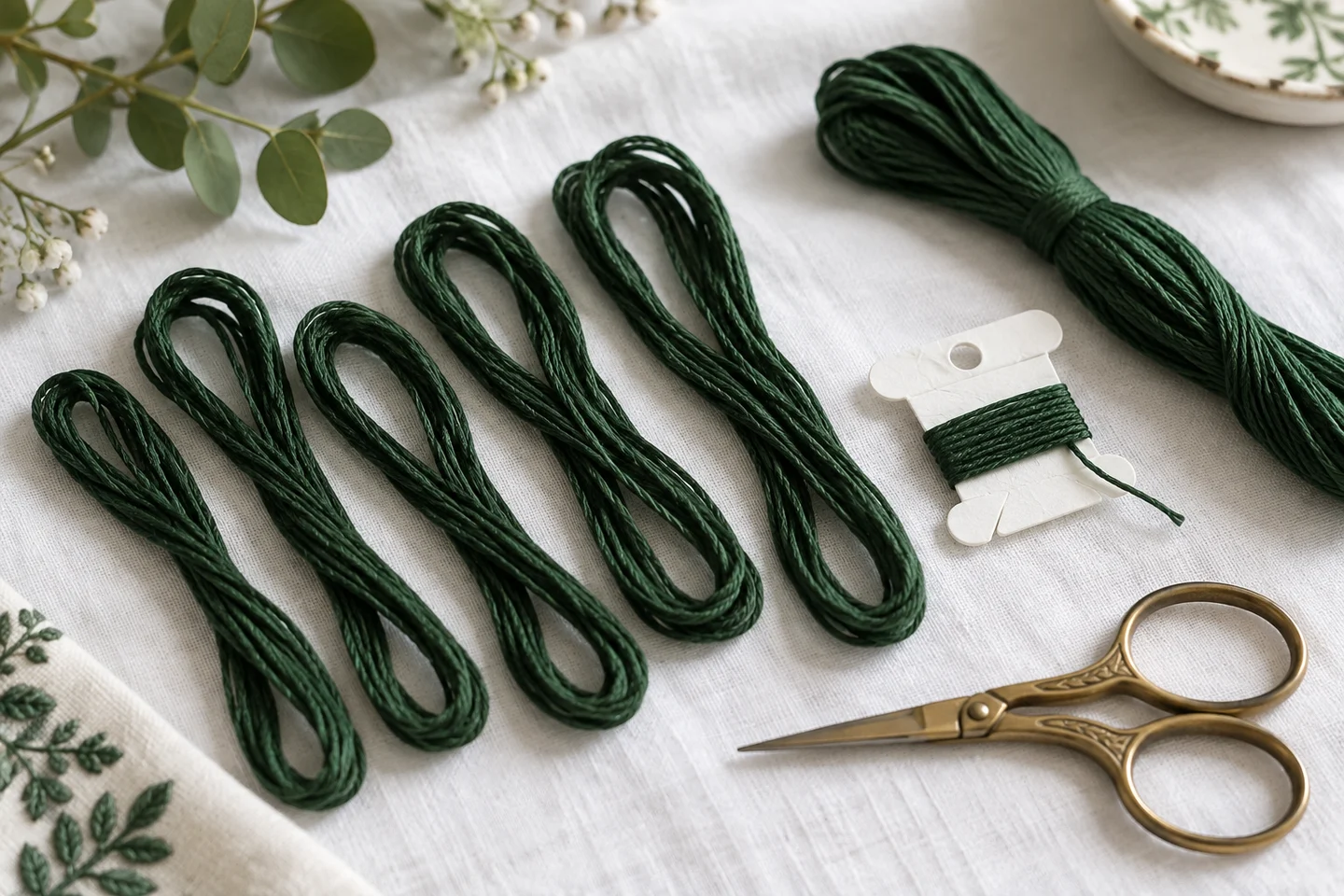
Estimate one color at a time
Use the number of filled cells assigned to that color, not the whole chart rectangle. A sparse flower on a 40 × 40 grid does not necessarily contain 1,600 stitches. Separate the colors because each must be rounded to purchasable skeins independently. A total of eight meters spread over six colors does not mean one mixed-color skein will do.
Understand the model
Our estimator counts two diagonal legs and two stitch-side lengths of travel per strand. It multiplies by the working strands, converts to equivalent six-strand floss length and adds your allowance. This is a transparent planning model, not a measurement of your hand movements. It can understate long carries or frequent tiny sections.
Calibrate with your own sample
Measure a length of thread, stitch a representative block and measure what remains. Include the start and finish if those are typical of the project. A sample of solid rows will not predict a confetti-heavy portrait well. Use your result to adjust the allowance rather than assuming the default is exact.
Buy with practical continuity in mind
Round each color upward to whole skeins and consider matching dye lots when consistency matters. Record the brand, color number and lot from the physical thread you choose. Our generic palettes do not provide official brand codes. Store leftover strands with their labels so they remain usable. Start with the Meadow Bloom chart’s per-color counts in the floss estimator, compare the suggested amount with a small test, and add extra for your own stitching style.
Begin with stitch counts for individual colors
A useful floss estimate starts with the number of stitches assigned to each color, rather than the overall chart rectangle. A sparse flower and a full-coverage photograph can share the same width and height while consuming very different quantities of thread. Count the occupied cells for each color when that information is available. If your chart provides a thread list, check whether it reports actual stitch counts, an estimated length, or a recommended number of skeins; those are related but different measurements.
Use the floss estimator as a planning aid, then compare the result with the pattern designer's instructions and your own sample. Keep each color separate when deciding what to buy. Combining all colors into one total can conceal a shortage of the dominant background shade. A design with several hundred small accent stitches may need less of each accent than the rounding to a full skein suggests, while the single most common color may require several skeins.
Understand why the path on the back matters
A cross has two diagonal legs on the front, but the thread also travels on the back. Continuous rows, isolated stitches and scattered confetti do not use thread in the same way. Starting and finishing a color consumes additional length, and traveling between separated groups adds more. An estimate based only on the visible diagonals therefore understates the working material needed. The estimator includes an approximate back-path allowance, but it cannot reproduce every movement of your needle.
Imagine two charts containing the same number of red stitches. In one, they form a solid rectangular block. In the other, they appear as individual dots spread across a large design. The second layout may require more starts, stops or careful traveling, even though its stitch count is identical. Use a larger practical reserve when the layout is fragmented, and consider simplifying unnecessary isolated cells during design. The photo color selection guide explains how palette decisions influence the stitching workload as well as the picture.
Match the strand setting to the actual project
Stranded embroidery cotton commonly contains six separable strands. If you stitch with two strands, the length passing through the fabric is not the same as the equivalent length of six-strand floss taken from the skein. A calculator must account for that difference. Enter the number of strands you will actually use, and check whether the output refers to full six-strand floss or working thread. Confusing these units can produce a large purchasing error even when every other number is correct.
Coverage also depends on the fabric, thread and your tension. Do not choose a strand count solely because it makes an estimate smaller. Stitch a test patch on the chosen fabric and view it under the lighting in which the finished piece will be displayed. Dark fabric under pale thread and pale fabric under dark thread can make gaps particularly noticeable. Follow any specific pattern instructions and use the fabric count guide to understand how changing the count alters the size of each cross.
Use fabric count consistently in the estimate
Larger stitches generally consume more thread than smaller stitches. The estimator's count input should describe the effective number of stitches per inch for the project. If you work over two threads on 28-count evenweave, the effective stitch density is fourteen per inch. Entering twenty-eight without accounting for the over-two method would suggest much smaller stitches and underestimate consumption. Confirm the calculator's labels whenever you move between Aida and evenweave so the same word does not hide a different assumption.
Changing from fourteen to eighteen stitches per inch reduces the physical size of the design, but it does not automatically tell you how many skeins to remove from the shopping list. You may choose a different strand count, use a different finishing method or work with a thread that behaves differently. Recalculate with all the final settings, then round purchases by color. The fabric size calculation guide can help you keep the thread and cloth plans based on the same finished chart.
Add a reserve for real working conditions
Thread reserves cover ordinary variation: tails secured at the beginning and end, occasional knots, damaged lengths, unpicking and travel between groups. No single percentage suits every project. A compact beginner motif may use thread predictably, while a detailed portrait with many isolated colors creates more uncertainty. Choose a reserve appropriate to the design and your habits rather than treating the smallest possible result as a guaranteed requirement. The goal is a workable project, not an artificially precise shopping total.
Use caution when a calculated amount is very close to a full skein boundary. A tiny theoretical remainder leaves little room for mistakes or differences between the assumed and actual skein length. Check the length printed on the thread packaging, because not every product has the same quantity. Specialty threads may be sold in different units or structures. If matching dye lots matters for the project, buying the intended quantity together can be more practical than returning later for a nearly matching replacement.
Measure a sample to improve the next estimate
A small sample can turn a generic estimate into a more personal one. Measure a known working length, stitch a counted patch using your planned strand count and tension, and record the usable thread remaining. Include how you started and ended the thread. Repeat with a representative scattered area if the project contains substantial confetti. This is not laboratory precision, but it reveals whether your technique uses noticeably more material than a simplified model predicts.
Keep the sample conditions with your notes: fabric count, number of strands, stitch count and whether the stitches were worked in rows or individually. Do not transfer a measurement from a dense block on fine fabric directly to a large open motif on coarse fabric. When you have several completed projects, compare their actual use with the estimates. That record is more valuable than a universal claim about how many stitches every skein must produce, because your designs and stitching habits are part of the calculation.
Organize the palette before buying more thread
Inventory the floss you already own, noting shade identifiers, brand, condition and approximate remaining length. Similar-looking colors are not always interchangeable, especially where subtle shading defines a face or a pet's markings. Keep loose remnants labeled so that you can distinguish a deliberate substitution from an accidental mix. The site's generated palettes use generic color references; they are not verified manufacturer thread codes. Choose physical floss under neutral light and test neighboring shades together before committing a large area.
For an original design, fewer well-separated colors often make purchasing and sorting easier. That does not mean every photograph should be reduced to the smallest palette. Protect important contrast first, then remove colors that contribute little visible information. The image converter size and colors guide describes that tradeoff. A small original chart such as Sunny Daisy is also a useful exercise in organizing a short palette before attempting a project with dozens of thread choices.
Keep purchasing decisions separate from promises
An estimate should help you prepare, but it should not be presented as a guaranteed minimum or a promise that you will never need another skein. Fabric variations, stitch technique and thread products introduce uncertainty. Record the assumptions alongside the result, and check them whenever the design changes. If a regenerated photo chart has a different palette, its old thread counts no longer describe the current project, even when the source photo and overall dimensions appear unchanged.
Before ordering, verify the final chart, effective count, strand count, per-color stitch totals and actual skein length. Round each color independently and consider the practicality of an additional reserve for prominent shades. Store unused floss with its label when the project is finished; it can support repairs or a matching gift later. For a complete preparation routine, combine this estimate with the supplies checklist and the fabric size tool, so thread, cloth and finishing plans agree before the first stitch.
Embroidery floss estimator · Download the original meadow bloom pattern
Examples, diagrams and planning estimates are original Cross Stitch Creator content.