
Beautiful crochet stitches balance appearance, drape, yarn use and the job the fabric must do. Compare open, solid and textured options with the same yarn before choosing a stitch from a close-up photograph.
What is the prettiest crochet stitch?
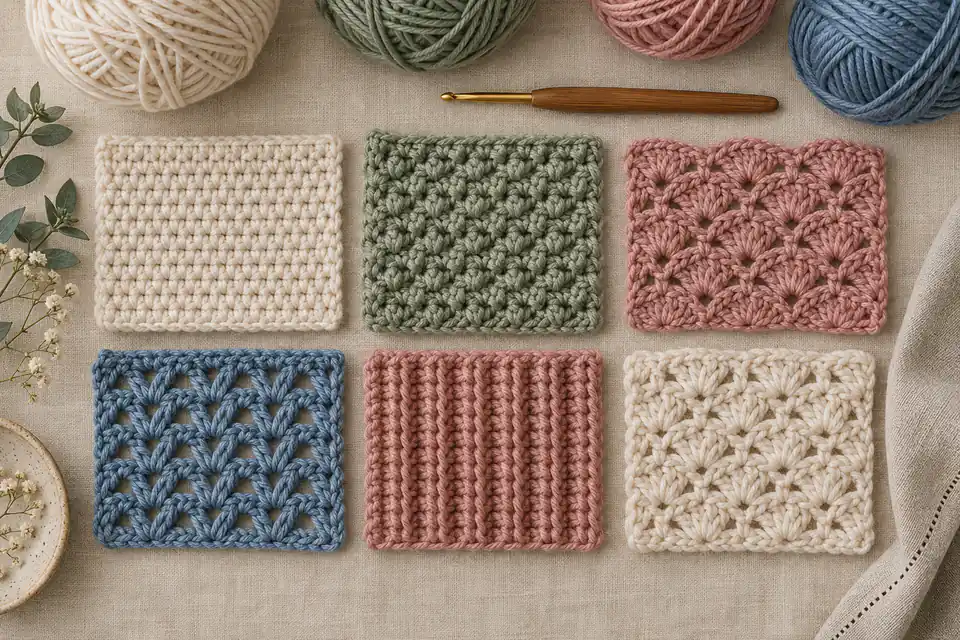
There is no objective prettiest crochet stitch. A crisp shell can look elegant in smooth cotton, a linen stitch can feel refined in quiet colors, and simple ribbing can become the strongest choice when the shape needs structure. Beauty also changes with scale: a motif that is striking in a close photograph may look busy across a blanket. Decide what you want viewers to notice—color, negative space, texture or silhouette—then choose a stitch that supports it. Make swatches large enough to show at least three repeats and include the border you plan to use. Wash and dry them before comparing. A beautiful finished object needs consistent edges, suitable drape and proportions as much as a decorative stitch.
Which crochet stitch is not a yarn eater?
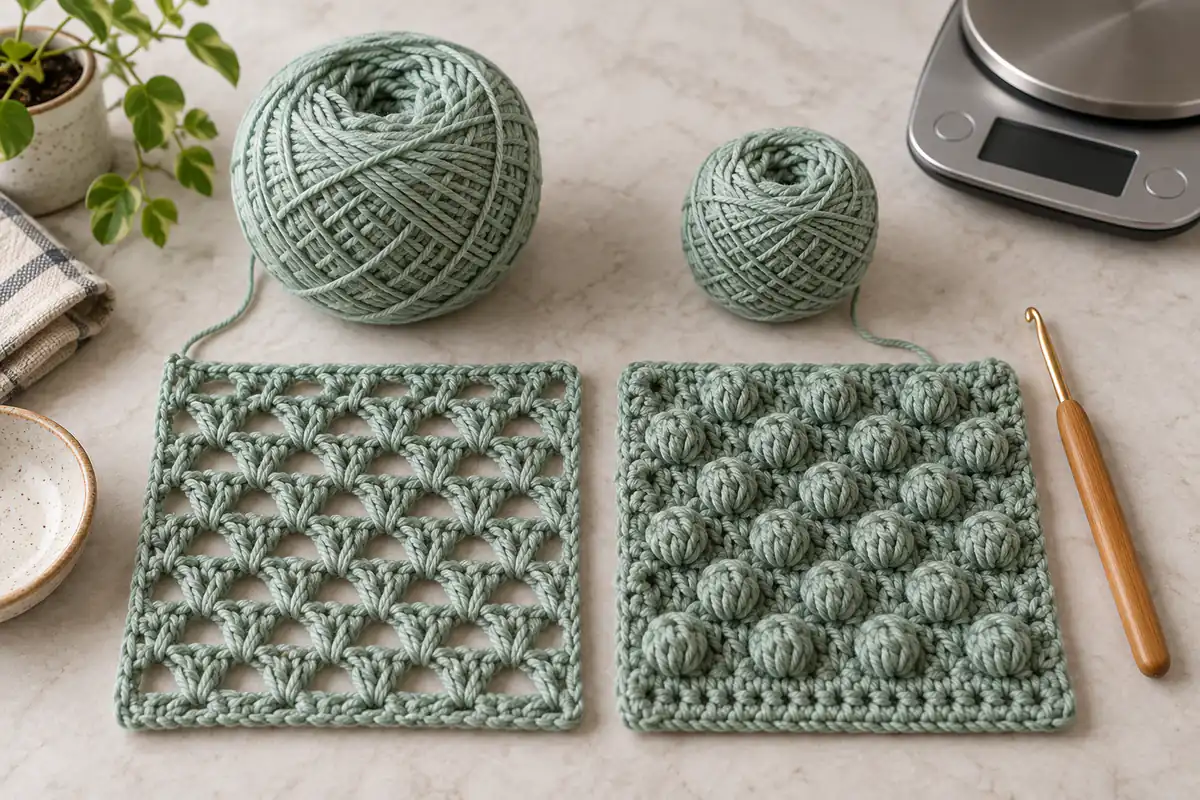
Open stitches generally use less yarn per square area than dense, highly textured stitches, but there is no single winner for every yarn, hook and tension. Mesh, V-stitch and open shell patterns often cover area efficiently because they include chain spaces. Linen or moss stitch gives a tidy surface with moderate density, while bobbles, puffs, cables and some post-stitch patterns can consume more yarn. Compare by making equal-size washed swatches and weighing them on the same scale. Our crochet yarn estimator can scale a measured sample to a planned area. Do not compare only the number of stitches: taller stitches, multiple loops and chain spaces change the yarn required. The lightest swatch is useful only if its holes, warmth and durability suit the project.
V-stitch for open, rhythmic fabric
A basic V-stitch groups tall stitches around a chain space, producing clear columns and quick visual progress. It suits scarves, light throws and simple garments when you want openness without an intricate chart. The exact V varies by pattern—some use two double crochets, others add more stitches or chains—so follow the stated multiple and edge instructions. Count the V groups instead of relying on the gaps by sight, especially in the first rows. A larger hook increases drape and openness but can also make the fabric unstable. Swatch the intended border because a tight edging may pull the open body inward. V-stitch also shows color changes clearly, making it a useful choice for controlled stripes or gradual leftovers.
Shell stitches for graceful curves
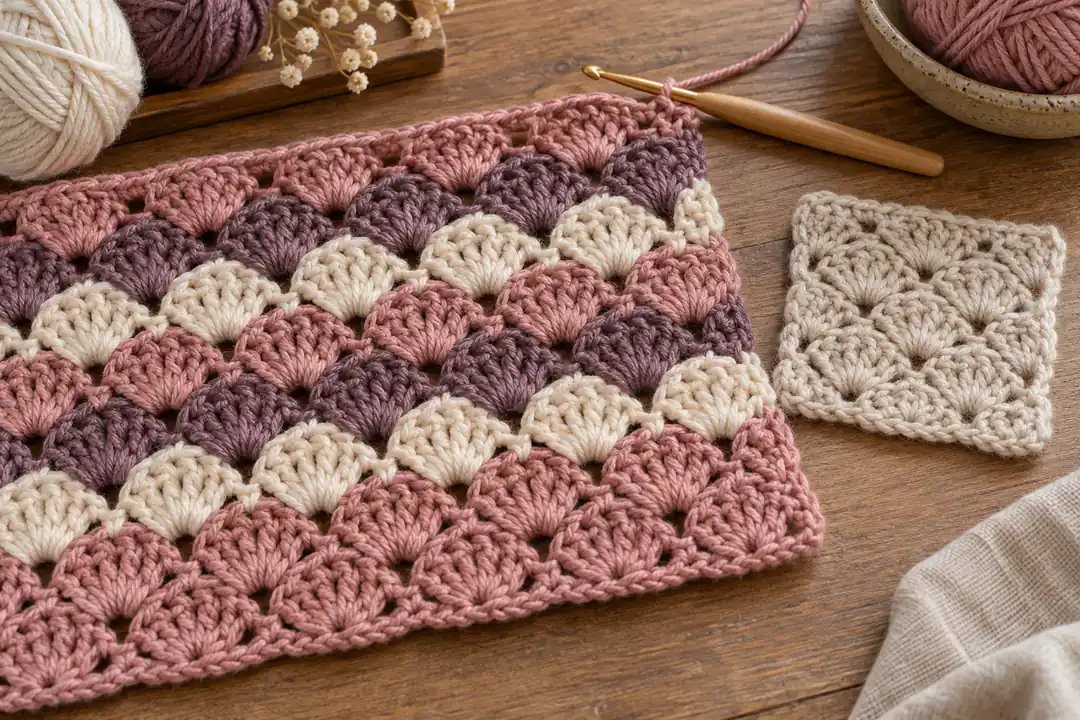
Shells place several stitches into one location, creating fans or scallops. They can appear delicate in fine yarn or bold in a heavier fiber. The fabric’s density depends on the number and height of stitches, the spaces between shells and the rows used to anchor them. Because multiple stitches enter one point, shells may use more yarn than a simple mesh while still leaving decorative openings. Check the pattern’s stitch multiple before setting width; our blanket chain calculator can help reconcile a repeat with the target size. Keep the center of each shell easy to identify and count complete motifs at the end of each row. A simple border often lets the curves remain the main feature.
Linen stitch for quiet color mixing
Linen stitch, often called moss stitch in many patterns, alternates compact stitches and chain spaces. It creates a woven-looking surface that works well for stripes, scarves, blankets and small accessories. Frequent color changes can blend scraps without adding a complex texture. Names and starting methods vary, so use the pattern’s written structure rather than assuming every “linen stitch” is identical. Insert into the chain spaces consistently and avoid tightening the chains, which can make the fabric stiff and narrow. The stitch is not as airy as open mesh and not as sculptural as bobbles; its beauty comes from even rhythm and color placement. Test fringe or edging on the swatch because the clean, quiet surface can be overwhelmed by a heavy finish.
Lemon peel stitch for simple texture
Lemon peel stitch usually alternates short and tall basic stitches, then reverses their positions on the next row. The contrast in height creates a pebbled texture without separate motifs or complex post stitches. It is approachable once you can distinguish the stitch types and read the edge correctly. Use a marker if the first and last stitches are easy to miss. The fabric is relatively solid, which suits cloths, accessories and selected home pieces, but yarn fiber should match the intended care and use. A strongly twisted yarn makes the texture crisp; a halo can soften it. Count the full alternating sequence so a missed stitch does not shift the pattern across subsequent rows.
Ribbing and raised lines
Crochet ribbing can be made through back-loop work, slip stitches or post stitches, and each method produces different stretch and thickness. Back-loop rows create visible ridges and are common for cuffs and hat bands. Slip-stitch ribbing can be elastic and refined but slow, while post-stitch ribs add strong relief and more bulk. Work a swatch in the direction the piece will be worn, then stretch and release it several times. Measure recovery, not only the resting width. Raised lines also frame panels and guide color changes, but too many can make a garment heavy. Use texture where it supports fit or structure. A neat band in a simple stitch often looks more polished than adding several decorative techniques to the same edge.
What is the drunken granny stitch?
“Drunken granny stitch” is an informal name used online for more than one offset granny-style arrangement. There is no universal standard that guarantees two patterns with this title use the same repeat. Typically, clustered tall stitches and chain spaces shift or lean across rows, creating a staggered open texture. Read the complete written instructions or chart and make a sample before purchasing project quantities. Check the turning rule, stitch multiple and whether the edge needs balancing stitches. The pattern can make lively scarves and blankets, but its openness and yarn use depend on the specific version. When sharing your project notes, record the actual repeat instead of relying on the nickname; that makes the fabric reproducible if the original page changes.
Is Tunisian crochet a stitch or a technique?
Tunisian crochet is a broader technique worked with a long hook or cable hook, commonly using a forward pass that collects loops and a return pass that works them off. It includes many stitches, from a simple woven-looking fabric to lace and colorwork. The resulting fabric can be dense and may curl, so hook size, fiber, blocking and edge treatment matter. It is not automatically a yarn-saving alternative to ordinary crochet. If a Tunisian texture attracts you, start with a small panel and learn the first and last stitch placement, which controls the edges. Use the hook size chart for systems and measurements, then follow a Tunisian pattern’s own recommendation because the hook often needs to be larger than expected.
How do I compare yarn use fairly?
Make swatches with the same yarn, target dimensions and finishing method. Record hook, stitch repeat, starting count, rows, unwashed size, washed size and weight. A ten-centimeter square is a practical minimum, but a larger sample better represents big motifs and drape. Calculate grams per square centimeter or ounce per square inch, then scale with an allowance for borders, seams and uncertainty. Also compare time: a light stitch that needs difficult corrections may not be efficient for you. Photograph each sample against the same background so color and openings are easier to judge. The goal is not to crown one universally efficient stitch; it is to choose the fabric that delivers the right coverage, feel and appearance for a known amount of yarn.
How do color and fiber change the result?
Solid light colors reveal shadows and stitch anatomy, while variegated yarn can either animate a simple stitch or obscure a complicated one. Strong color contrast emphasizes modular and mosaic geometry. Fiber changes structure: cotton may show crisp definition, wool can bloom after washing, and smooth synthetic yarn can emphasize shine or spring. These are tendencies, not guarantees, because construction and blend matter. Make the stitch in the actual yarn rather than choosing from a sample photographed in another fiber. If you substitute, compare length per ball and care instructions as well as weight category. A stitch intended for heat protection, infant use or frequent washing also needs appropriate material and safety choices. Beauty lasts longer when the fabric remains practical after repeated use.
Choose a stitch with a swatch matrix
Select three candidate stitches and make them in the same yarn. Label each swatch, wash it, then rate appearance, drape, coverage, weight, time and ease of correction. Measure gauge and yarn use instead of relying on memory. For a fitted or modular project, use the crochet gauge calculator; for a large rectangle, connect the sample weight to the yarn estimate. View the swatches from close range and from across the room. Pick the one whose strengths match the object: openness for a summer layer, density for a bag, texture for a cushion, or rhythm for a relaxing blanket. That method turns “prettiest” from a vague ranking into a confident project decision.
Examples, diagrams and planning estimates are original Cross Stitch Creator content.